


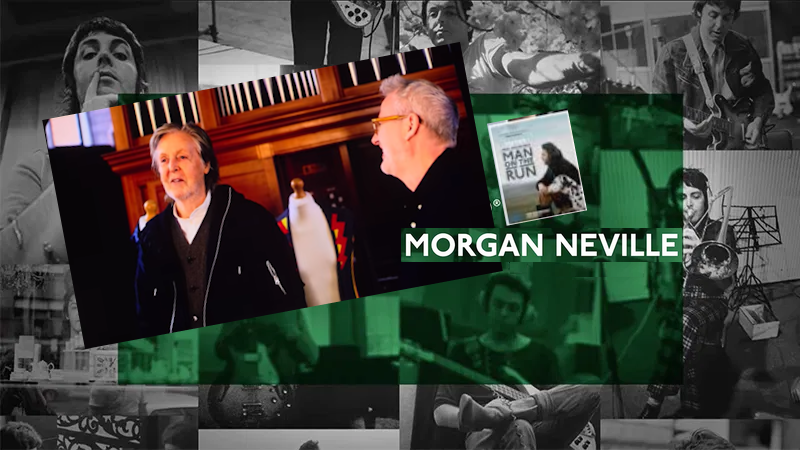
“We could get together at different times or just be the two of us and talk and talk.” Paul’s been interviewed probably about as many times as any human,”says Neville, who won an Academy Award for Best Documentary Feature for 2013’s 20 Feet from Stardom, about background singers. He asked Paul about things large and small, from parenting and legacy to why he used a particular bass.
“I do feel like I got Paul to go way deeper than he normally goes, and part of that was I had the luxury of interviewing him many times over many months,” he explains. Neville’s goal was “to show his vulnerability—because this part of his life was professionally the most difficult of his career—but also his toughness. Paul can be so charming and amiable, but you don’t really become Paul McCartney if you don’t have some serious grit and steel in you.”

Neville says Paul allowed him to tell the story as he saw fit. “Paul gave me zero direction on this film in the beginning, the middle, or the end,” “I did not get a single note from Paul ever about what the film should or shouldn’t be. And in many ways, the way he’s reacted to the film has been like it’s explaining something to him that he didn’t quite fully put together.”
With the Beatles’ breakup looming, McCartney’s 1970 solo debut arrived as a minimalist project that Neville likens to a ‘Bon Iver-style’ record. Yet, the documentary opens not with this raw sound, but with the upbeat energy of ‘Silly Love Songs.’ This 1976 Wings hit serves as a prime example of what many critics dismissed as McCartney’s transition into overly sentimental, ‘sugary’ pop after leaving his former band.
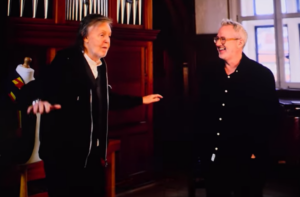
“It’s kind of a mission statement for him of why he does what he does,” Neville says of the song. “John was so of his time, and John’s writing songs about John Sinclair and the Black Panthers and was involved with all these political movements, and Paul’s pulled himself out of all of it. He did songs like ‘Give Ireland Back to the Irish’ … but he wasn’t marching in activist rallies like John was. And at the time it just made him seem incredibly uncool.”
“I think he’s kind of realizing that Wings were better than everybody told him,” Neville says. “He internalized a lot of the criticism. He’s added more Wings songs to his sets over the years.” “I ended up focusing a lot on his failures too,” he says. “Ultimately, the story just has to service what I think is the best story. Hagiography is terrible storytelling.”
“I tell people this when I start a film: ‘I’m not here to praise you, and I’m not here to bury you. I’m just here to understand you,’” Neville says. “That’s my job. And if somebody is game for that, then you can have an amazingly creative experience.”

🟠We invite WELCOME! FOLLOW US! VISIT US HERE:
www.beatlesmagazine.com
https://www.facebook.com/BEATLESMAGAZINE1/
https://beatlesmagazine.blogspot.com/
https://beatlesmagazinebootleg.blogspot.com/
https://beatlesmagazinevideo.blogspot.com/
https://www.instagram.com/beatlesmagazine/
https://x.com/BEATLESMAGAZINE
https://www.tiktok.com/@beatlesmagazine
https://www.threads.net/@beatlesmagazine
🟠BEATLES STORES (Associated with Amazon, Shipments Worldwide)→ HERE , HERE & HERE
🟠VISIT PAUL McCARTNEY’s OFFICIAL AMAZON STORE: https://amzn.to/4r3DN4w
#USA 🇺🇸: https://amzn.to/3417JGy
#UK 🇬🇧: https://amzn.to/3qVcsDy
#JAPAN 🇯🇵 : https://amzn.to/3FbWKsO
#GERMANY 🇩🇪: https://amzn.to/3r6s5IB
#FRANCE 🇫🇷: https://amzn.to/3ty8zaX
#SPAIN 🇪🇸: https://amzn.to/3qfiS1s
👉Visit us : https://linktr.ee/BEATLESMAGAZINE
