

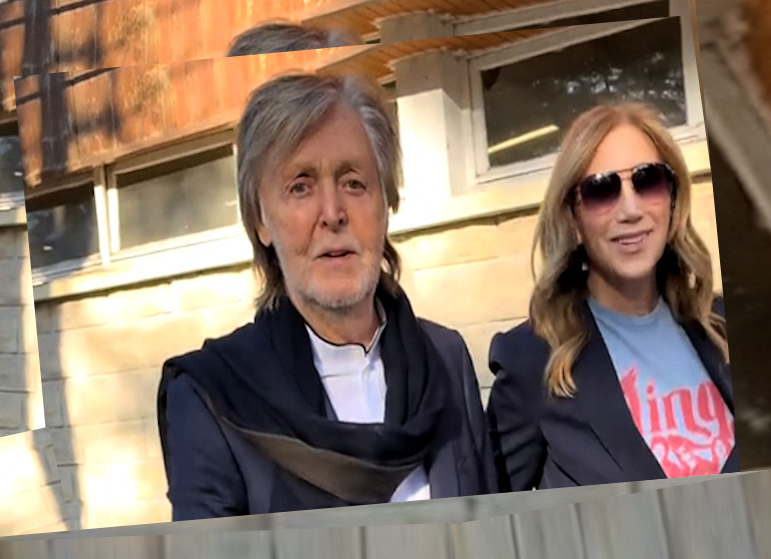
In a recent interview, Paul McCartney talks about his latest album, The Boys on Dungeon Lane, and the stories behind each song. But there is one particular track that Paul explains how he came to write. It was during a recent episode of the Song Exploder podcast where he reveals how his songwriting ideas come to him.
Regarding the song ‘Ripples in a Pond,’ Paul shares how the idea for the track came to him.
“I was in East Sussex, England, on uh, my farm where I live. Just sitting around, enjoying a day off. And that’s normally when I write songs, if I’m lucky enough to know that I’ve got the next three or four hours and nobody’s gonna interrupt me. And I was actually thinking about my missus, Nancy. And thinking, you know, how lucky I am to know and love someone like her. We’ve known each other quite a long time and it’s a very interesting relationship. We’re nothing like each other.”
And Paul went on to say:
“I mean, I’m English, she’s American. She’s very practical. Get things done. I’m much more sort of whimsical. I will get things done, but in… maybe not as practical a way. But we know each other and we know how to be with each other. So I was just thinking about how blessed I am. You know, anyone who’s in a good relationship with someone is inevitably really blessed. And it’s nice, when you’re thinking that, to introduce that idea into a song.
And, I’m often just sitting around with a guitar. If I find a couple of nice chords, Then I’ll strum them and see if it leads me anywhere. That’s the process for me, is doing the chords. But then, like, almost immediately I will try and block it out with words. Even if it’s nonsense, it at least shows you where you want the song to go.
I mean, for instance, years and years ago with the Beatles, I had dreamed the melody to “Yesterday,” and I didn’t have any words to it, so I, I blocked it out by singing “scrambled eggs, oh my baby, how I love your legs.” So we had scrambled eggs and legs, but at least it helped me remember it. So you sometimes do that. And so, after I’d sort of found some chords on the guitar, I often then will see what happens when I put it on the piano. And this actually worked better on the piano. The way the chords seemed to me to, uh, sing a bit more.
That was a very early, early version. I didn’t have the lyrics ironed out, but I had the feeling. So, that was what it was. I was now fishing around. I call it fishing. You know, just fishing around, see what might come. Because I don’t know. I don’t know this song. Nobody knows this song till I’ve written it. So it’s nice. It’s a sort of quest. Uh, it’s like following a trail of breadcrumbs in the woods. You’re not quite sure where it’s gonna lead, but it’s fun just to see if it reaches a good place. So that’s the process, really. I, you know, do the little demo and then if I’m at the studio, I will then say to Steve, my engineer, “I’ve got this song, you know. Let’s try and put it down.” So we’ll try and make something a bit more of it, but it’s still not concentrating on making the record.”
Paul further explains where the phrase ‘ripples in a pond’ came from…
“I like the “ripples in a pond” idea because it’s a good image for me. For instance, if people pray, the idea is that you pray and it creates ripples, and it goes and it reaches the deity you’re praying to. I like the idea of saying something and it ripples out into the universe. And, I like the idea in a romance of saying, let’s see how far it goes. ‘Cause you can’t plan it. You can hope it’s going to work, and you can hope it’s going to work out well, but there is an element of guesswork where you’re just saying, you know, “Fingers crossed.”
The number of people who would like to collaborate in some way with Paul McCartney is incalculable; faced with this, Paul admits that for him, it is necessary to get to know the other person he works with better, seeking the kind of relationship he had with John Lennon in terms of songwriting:
“Yeah, I think so,- Paul said,-. Because, you know, working with John Lennon was something
that happened when we were kids. Neither of us really knew how to write songs, so it just grew organically.
And because John and I had such a natural relationship that had matured together, I’m inevitably comparing whoever the next person is I’m writing with. And as time went on and the Beatles broke up and I was no longer writing with John, I did try working with a couple of other people.
But yeah, you’re right that, that having worked with John, now for someone to just
come into the room and we don’t necessarily know much about each other, that
does make it a bit harder, I must admit.”
In the intro of the song,(intro guitar flourish) there’s a little thing that happens at the end of the lead guitar part…
“Yeah, if I’m putting the first bit on, I know that I can mess around afterwards and just do something free. Because if we don’t like it, we can just not use it and just cut it off. But if we do like it, it can find its way in there as just a little something, a little tasty something, you know?
I’m glad that you get the idea that we’re having fun, because that is what it is. And it’s also a romantic song for my wife. So I can say to her, “This is about you.” I, in fact, it’s funny, I played it for her recently and I don’t think she knew that it was specifically about her! I don’t know who she thought it was about. But this was specifically about her. So I thought, you know, it’s about time that I finished it up, played it to her and told her, “This is about you.”
There is a particular sound in the song… Paul says regarding this:
“It’s a vocal. I’ve got a Vox amp that I’d use mainly for guitar, but it has a tremolo. So if you put a noise through it, a, a guitar thing, it’s going ja, ja, ja, ja, ja, ja, ja.
So again, in the spirit of fishing around for interesting ideas, I said, “Well, let’s try putting the vocal through it.” So instead of it just going, “Na, na,” we put it through that and it went, “Na-na-na-na-na-na-na-na-na-na-na-na-na-na-na…”
You know, I’m glad that I haven’t reached the point where I’m so blasé that I just wanna just get on, write a song, record it, go home. I like the process of discovering new sounds and new ideas. And sometimes you don’t hardly hear them ’til you’ve heard the song 20 times. And you go, “What is that little noise?” You know. But I think that’s the fun, that’s the fascination of it.
We made this sound and had fun making it. That’s all I want in life.”
………………………………………………………
🟠Would you like to support the page with a donation? Enter HERE
 Join the Beatles Subscriber Zone here:
🟠We invite WELCOME! FOLLOW US! VISIT US HERE:
www.beatlesmagazine.com
https://www.facebook.com/BEATLESMAGAZINE1/
https://beatlesmagazine.blogspot.com/
https://beatlesmagazinebootleg.blogspot.com/
https://beatlesmagazinevideo.blogspot.com/
https://www.instagram.com/beatlesmagazine/
https://x.com/BEATLESMAGAZINE
https://www.tiktok.com/@beatlesmagazine
https://www.threads.net/@beatlesmagazine
🟠BEATLES STORES (Associated with Amazon, Shipments Worldwide)→ HERE , HERE & HERE
🟠VISIT PAUL McCARTNEY’s OFFICIAL AMAZON STORE: https://amzn.to/4r3DN4w
#USA 🇺🇸: https://amzn.to/3417JGy
#UK 🇬🇧: https://amzn.to/3qVcsDy
#JAPAN 🇯🇵 : https://amzn.to/3FbWKsO
#GERMANY 🇩🇪: https://amzn.to/3r6s5IB
#FRANCE 🇫🇷: https://amzn.to/3ty8zaX
#SPAIN 🇪🇸: https://amzn.to/3qfiS1s
👉Visit us : https://linktr.ee/BEATLESMAGAZINE
