
The Beatles, issued their eleventh studio effort, Abbey Road, on September 26, 1969, via Apple Records. While it was the final record the band completed, the public got Let It Be in 1970, which was the final album released before the group’s dissolution in April 1970.
The bulk of the recording took place during April, July, and August 1969. Upon its release, it quickly ascended to the number one spot on the record charts in both the United States and the United Kingdom. A successful double A-side single, “Something” / “Come Together,” was released in October and also topped the US charts.
Musical Style and Legacy
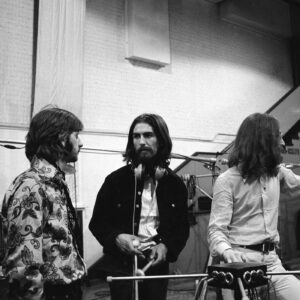
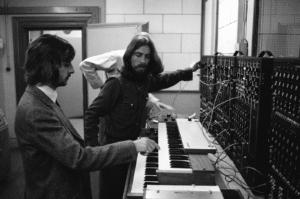
Abbey Road is an eclectic blend, encompassing styles such as rock, pop, blues, and progressive rock. It’s technically notable for its heavy use of the Moog synthesizer and guitar effects achieved through a Leslie speaker unit. A defining feature of the album is the long medley of interconnected songs on the second side, which has since been covered as a single piece by various artists.
The recording sessions were reportedly more cooperative than the troubled Get Back / Let It Be sessions earlier that year. However, internal friction persisted, particularly concerning Paul McCartney’s song “Maxwell’s Silver Hammer,” and John Lennon was absent from the recording of several tracks. By the time Abbey Road hit the shelves, Lennon had already privately left the group, though the public wouldn’t know until McCartney’s departure the following year.
While Abbey Road was an immediate commercial smash, initial reviews were mixed. Some critics dismissed the music as inauthentic and found fault with the perceived artificiality of the production. Despite this, critical opinion has since drastically improved, and the album is now overwhelmingly regarded as one of The Beatles’ finest works and a contender for the greatest album ever made. George Harrison’s two compositions, “Something” and “Here Comes the Sun,” are frequently cited as among the best songs he ever contributed to the band.
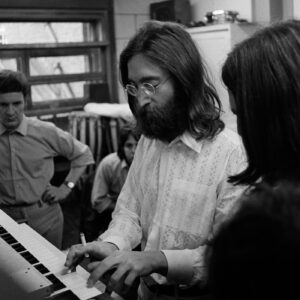
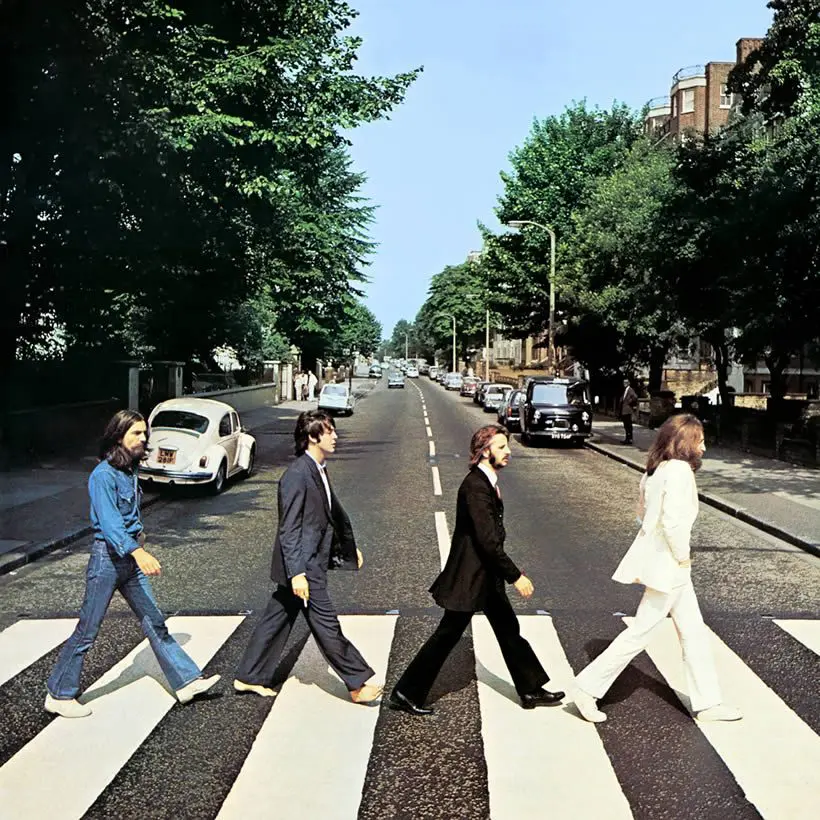
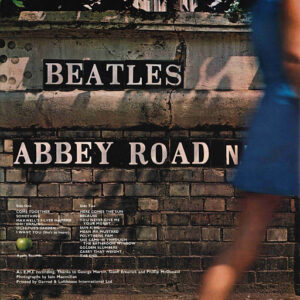
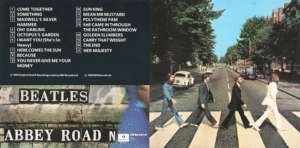
The album’s simple yet iconic artwork, which shows The Beatles walking in single file across the zebra crossing (pedestrian crossing) outside Abbey Road Studios (then officially known as EMI Studios), is arguably one of the most recognizable and imitated album covers in music history.
The creation of The Beatles’ Abbey Road began shortly after the Get Back sessions, with the very first recording taking place on February 22, 1969, at Trident Studios. This initial work involved laying down the rhythm track for “I Want You (She’s So Heavy),” with Billy Preston joining on the Hammond organ.
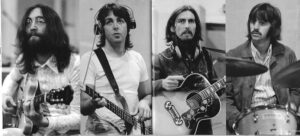
Progress was halted because Ringo Starr was busy with the film The Magic Christian, meaning no substantial group recording occurred until April. After a brief period of work and a session for “You Never Give Me Your Money” in early May, the band took an eight-week hiatus before fully committing to the album on July 2. Recording then continued steadily through July and August, with the final rhythm track for “Because” being taped on August 1. The final stage of the album, including overdubs and the crucial sequencing, was completed on August 20, marking the last time all four Beatles were together in the studio.
While some, including Paul McCartney, Ringo Starr, and producer George Martin, recalled the sessions positively, George Harrison noted that they “did actually perform like musicians again.” A brief period of renewed collaboration between John Lennon and McCartney on the non-album single “The Ballad of John and Yoko” seemed to bring some needed camaraderie into the Abbey Road sessions.
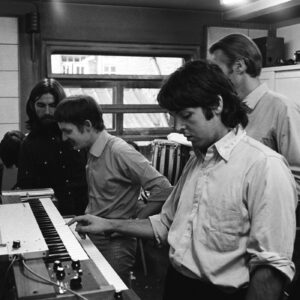
Despite this, internal friction was still very much present. Tensions included an “acrimonious argument” between McCartney and Lennon, and the constant presence of Lennon’s wife, Yoko Ono, in the studio, which reportedly caused clashes with the other band members. After Lennon and Ono were in a car accident, Lennon had a bed installed in the studio so Ono could observe the recording process while recovering.
A major creative compromise defined the album’s structure. Lennon initially wanted a more traditional album with his songs on one side and McCartney’s on the other, featuring distinct, separate songs. However, the final product merged this idea with McCartney and Martin’s vision for a thematic medley—a continuation of the style they explored on Sgt. Pepper’s Lonely Hearts Club Band.
Abbey Road represented a technical leap for The Beatles. Unlike previous albums, such as Sgt. Pepper, which were recorded on four-track equipment, Abbey Road utilized eight-track reel-to-reel tape machines. This album was also a milestone as it was the first Beatles record never to be released in a mono format anywhere globally.
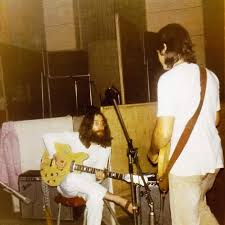
The album’s sound is notably defined by two key instruments. One is the prominent use of guitar fed through a Leslie speaker, and the other is the Moog synthesizer. The Moog isn’t merely an atmospheric backdrop; it plays a crucial role in several songs. For instance, it’s used as the main instrument for the middle section of “Because” and is also clearly audible in tracks like “Maxwell’s Silver Hammer” and “Here Comes the Sun.”
Original US and UK pressings of Abbey Road do not list “Her Majesty” on the album’s cover nor on the record label,[75] making it a hidden track.
By mid-1969, John Lennon was ready to move on, partially due to The Beatles rejecting his song “Cold Turkey,” leading him to form a new side project called the Plastic Ono Band. Meanwhile, George Harrison was busy collaborating with various artists like Billy Preston and Delaney & Bonnie, and Paul McCartney took a break following the birth of his daughter, Mary, on August 28.
Just six days before the release of Abbey Road, on September 20, 1969, John informed Paul, Ringo and manager Allen Klein (George was not present), that he was quitting the band, stating he “wanted a divorce.” The split, however, was kept quiet. Apple Records went ahead with the planned release of the double A-side single “Something” / “Come Together” in the US on October 6 and in the UK on October 31. John released “Cold Turkey” with the Plastic Ono Band that same month.
The band did virtually no promotion for Abbey Road. The public remained unaware of the group’s breakup until McCartney publicly announced his departure in April 1970. Although the majority of Abbey Road was recorded later, the previously shelved Get Back project—eventually renamed Let It Be—was revisited, with final mixing and overdubs stretching into 1970. Consequently, Let It Be became the last album the Beatles completed and released to the world.
Chart Performance and Sales
Abbey Road was an immediate commercial phenomenon, selling four million copies in its first two months. In the UK, it debuted at number one and held the top spot for 11 weeks. After a brief dip, it returned for another six weeks, totaling 17 weeks at number one and spending a total of 81 weeks on the charts. It was equally successful overseas, dominating the US charts for 11 weeks at number one on the Billboard Top LPs chart, and was named the year’s best-selling album by NARM. Its longevity was particularly notable in Japan, where it remained a top 100 fixture for nearly 300 weeks during the 1970s.
The Beatles
John Lennon – lead, harmony and background vocals; rhythm, lead and acoustic guitars; acoustic and electric pianos, Moog synthesiser; white noise generator and sound effects; percussion
Paul McCartney –lead, harmony and background vocals; bass, rhythm, lead and acoustic
guitars; acoustic and electric pianos, Moog synthesiser; sound effects; wind chimes, handclaps and percussion
George Harrison – harmony and background vocals; lead, rhythm, acoustic and bass guitars; Moog synthesiser; harmonium; handclaps and percussion; lead vocals (on “Something”, “Here Comes the Sun”, and “Because”)
Ringo Starr – drums and percussion; background vocals; anvil on “Maxwell’s Silver Hammer”; lead vocals (on “Octopus’s Garden”)
George Martin – organ, harpsichord, percussion
Billy Preston – Hammond organ (on “Something” and “I Want You (She’s So Heavy)”)
Production
“Something” and “Here Comes the Sun” orchestrated and conducted by George Martin (with George Harrison)
“Golden Slumbers”, “Carry That Weight” and “The End” orchestrated and conducted by George Martin (with Paul McCartney)
Produced by George Martin (with the Beatles)
Recorded by Geoff Emerick and Phil McDonald
Assistant engineering by Alan Parsons
Mixed by Geoff Emerick, Phil McDonald and George Martin (with the Beatles)
Moog programming by Mike Vickers
🟠Would you like to support the page with a donation? Enter HERE
🟠We invite you to visit our NEW Facebook Page FOLLOW US HERE:
WELCOME! FOLLOW US! VISIT US HERE:
www.beatlesmagazine.com
https://www.facebook.com/BEATLESMAGAZINE1/
https://beatlesmagazine.blogspot.com/
https://beatlesmagazinebootleg.blogspot.com/
https://beatlesmagazinevideo.blogspot.com/
https://www.instagram.com/beatlesmagazine/
https://x.com/BEATLESMAGAZINE
https://www.tiktok.com/@beatlesmagazine
https://www.threads.net/@beatlesmagazine
🟠BEATLES STORES (Associated with Amazon, Shipments Worldwide)→ HERE , HERE & HERE
#USA 🇺🇸: https://amzn.to/3417JGy
#UK 🇬🇧: https://amzn.to/3qVcsDy
#JAPAN 🇯🇵 : https://amzn.to/3FbWKsO
#GERMANY 🇩🇪: https://amzn.to/3r6s5IB
#FRANCE 🇫🇷: https://amzn.to/3ty8zaX
#SPAIN 🇪🇸: https://amzn.to/3qfiS1s
👉Visit us : https://linktr.ee/BEATLESMAGAZINE
