
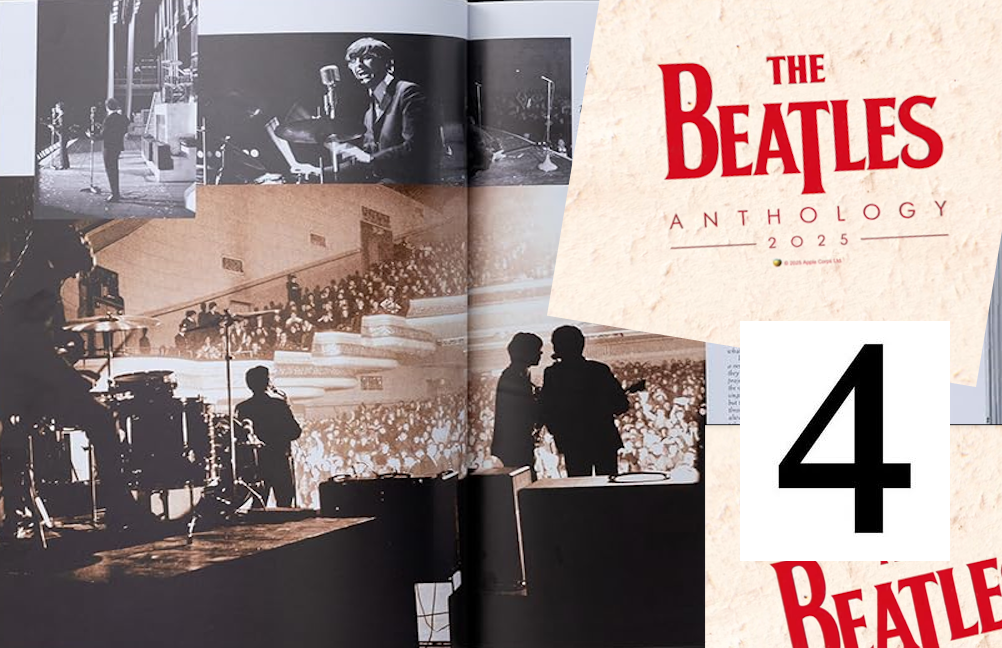
EPISODE FOUR
Their second US tour takes Beatlemania somewhere downright surreal, and you can hear the intensity of their experiences in much of the music. “It was like being in the eye of a hurricane,” says John, midway through a sequence based around their frantic version of Chuck Berry’s “Rock and Roll Music.” “You thought, ‘What’s going on?’ but that was about as deep as it got…You’d suddenly wake up in the middle of a concert or a happening and think, ‘How did I get here?’”
“Even when we got away from the screaming fans,” says George, “there were all the screaming policemen.” From George Martin, we hear another crisp illustration of their day-to-day reality: “The only peace they got was when they were in their hotel rooms, hearing the screams outside.”
Despite all the hysteria, their music is developing fast, and constantly taking on new colours and textures, thanks in part to their range of influences. A big source of inspiration is Bob Dylan, who first shares their company in a New York hotel room in September 1964, which is soon filled with fragrant smoke. Paul is convinced he’s found the meaning of life and asks The Beatles’ roadie Mal Evans to get a pen and pencil to make sure no-one forgets. The following morning, there it is: “There are seven levels.” A little later, while staying in Los Angeles, they have a mind-boggling meeting with Elvis, suddenly no longer the icon they marvelled at in Liverpool, but a moving, talking human being. But what really defines this chapter of their career is what happens back in London, in the recording studio: a restless quest for new sounds and mind-expanding departures that begins to kick in with “I Feel Fine” as far as anyone knows, the first track to feature deliberately-recorded feedback—and the “Beatles For Sale” album, released in late 1964.
The following year, they reach new creative heights. John and Paul write “Ticket To Ride,” a “heavy record” built on a sound no rock group has yet gotten near. Though no one realises it at the time, “Help!” finds John offering a bracing picture of his emotional state that looks ahead to a new kind of songwriting. Meanwhile, Paul comes up with a composition that confirms that his own creativity has entered a new phase.
“I just woke up one morning with this song in my head,” he says “and I thought, ‘I don’t know this song—do I?’ I hawked it around all my friends: ‘What’s this? It’s got to be something…’ I didn’t write it ‘cos I just dreamed it. You don’t get that lucky.” It turns out you do: this is “Yesterday.”
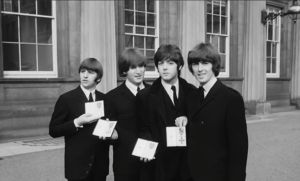
George’s songwriting is also starting to blossom. Amid constant laughter and multiple re-takes, they complete work on their second movie. The British government announces that they are to be made Members of the British Empire, which entails an encounter with the Queen, and sparks anger among the UK’s stuffy establishment. By now, it’s clear that The Beatles have arrived somewhere musicians have never been before—something confirmed by news that they are about to play a massive venue in the USA, and once again rewrite popular music’s rules.

🟠We invite you to visit our NEW Facebook Page FOLLOW US HERE:
WELCOME! FOLLOW US! VISIT US HERE:
www.beatlesmagazine.com
https://www.facebook.com/BEATLESMAGAZINE1/
https://beatlesmagazine.blogspot.com/
https://beatlesmagazinebootleg.blogspot.com/
https://beatlesmagazinevideo.blogspot.com/
https://www.instagram.com/beatlesmagazine/
https://x.com/BEATLESMAGAZINE
https://www.tiktok.com/@beatlesmagazine
https://www.threads.net/@beatlesmagazine
🟠BEATLES STORES (Associated with Amazon, Shipments Worldwide)→ HERE , HERE & HERE
#USA 🇺🇸: https://amzn.to/3417JGy
#UK 🇬🇧: https://amzn.to/3qVcsDy
#JAPAN 🇯🇵 : https://amzn.to/3FbWKsO
#GERMANY 🇩🇪: https://amzn.to/3r6s5IB
#FRANCE 🇫🇷: https://amzn.to/3ty8zaX
#SPAIN 🇪🇸: https://amzn.to/3qfiS1s
👉Visit us : https://linktr.ee/BEATLESMAGAZINE
