
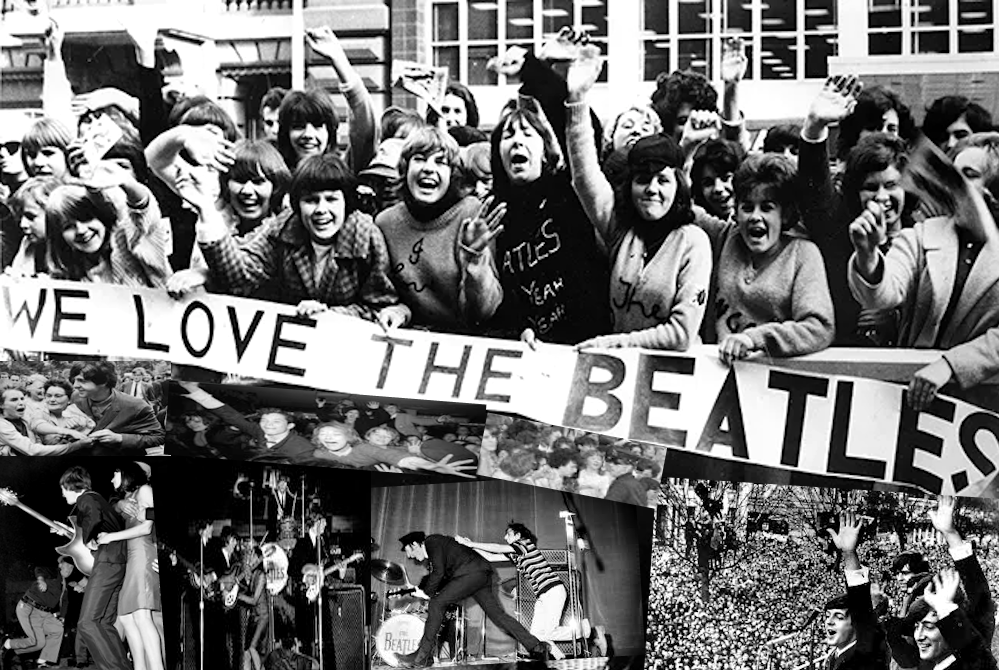
In the late sixties, long before algorithms, social media, or streaming, The Beatles achieved something that today seems almost impossible: synchronizing the emotions of millions of people in real time. It wasn’t just music. It was a total experience—media-driven, psychological, and cultural—that turned a band into the first emotional operating system for global youth. What the media narrated as collective hysteria was, in reality, the birth of something much deeper: modern fandom.
The media machinery: when television created a shared reality: The turning point came in 1964, when the Beatles appeared on The Ed Sullivan Show: more than 70 million people in the United States tuned into the broadcast. In an era with few channels and no digital distractions, this was equivalent to capturing the attention of almost an entire nation simultaneously.
By the end of the decade, that capacity for media synchronization remained key. Radio, television, and the press didn’t just inform: they constructed a unified narrative.
Philosopher Guy Debord had anticipated this in The Society of the Spectacle: modern reality is not lived directly, but through representations. The Beatles were one of the first phenomena where that idea became tangible.
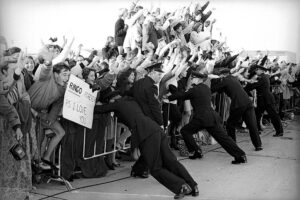
Images of screaming and fainting teenagers became iconic. But what seemed like media exaggeration has a scientific explanation today.
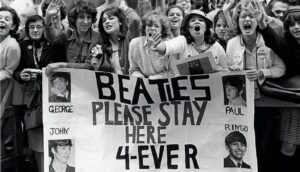
From neuroscience: Music activates reward circuits (dopamine), generating intense pleasure, Emotional contagion synchronizes reactions in crowds and Mirror neurons amplify the collective experience.
In terms of social theory, this fits with Henri Tajfel’s “social identity“: people define who they are based on the group to which they belong. Being a Beatles fan wasn’t a preference. It was an identity.
The media helped code each member as a recognizable archetype:
John Lennon: the introspective rebel
Paul McCartney: the melodic perfectionist
George Harrison: the spiritual seeker
Ringo Starr: the approachable, human one
This allowed for a deep connection. Each fan could see themselves reflected in one of them. Here, another key concept enters: parasocial relationships, described by Donald Horton and R. Richard Wohl. Fans developed one-sided emotional bonds, feeling they knew the artists intimately.
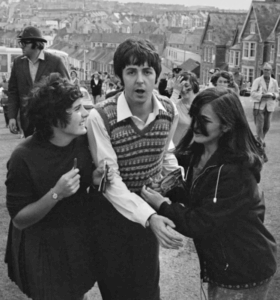 By 1967, something had changed. With Sgt. Pepper’s Lonely Hearts Club Band, the Beatles stopped making songs to create experiences. The record sold millions of copies and remained at the top of the charts for weeks. But even more importantly: it redefined how music was consumed. It was no longer about: Listening to a single. But rather: Immersing oneself in a complete universe.
Listening to an album became a collective and introspective ritual. In the height of the Summer of Love, music functioned as the shared language of a generation questioning war, authority, and social norms.
The Beatles phenomenon cannot be understood without its context: The Vietnam War generated distrust toward power, The Civil Rights Movement redefined justice and equality and, The counterculture proposed new ways of living.
The Beatles didn’t lead these changes, but they amplified them. They were the mirror where a generation saw itself reflected.
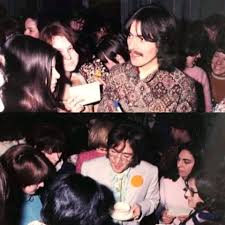
Around 1968–1969, the media changed its tone. The story stopped being a celebration and became one of tension: creative differences, personal distancing and individual projects.
What emerged was an almost tragic narrative: the disintegration of something that seemed perfect. For the fans, this was more than news. It was an emotional experience close to mourning. When unity breaks, so does the collective identity built around it.
Today we live in the era of hyper-connection. Phenomena like BTS or Taylor Swift mobilize millions of fans worldwide. But there is a crucial difference:
In the 60s → centralized and simultaneous experience
Today → fragmented and algorithmic experience
Before, everyone saw the same thing at the same time. Today, each user lives in their own feed. This changes the nature of fandom: more interactive, but less unified; More constant, but less transcendental.
Seen from today, the Beatles phenomenon wasn’t just musical. It was a rare convergence of factors: mass media without fragmentation, a generation in crisis and search, four figures capable of embodying multiple identities and an industry that, without knowing it, was creating the model for modern fandom.
The Beatles didn’t just dominate their time. They defined the emotional architecture of how we experience culture.
Conclusion: If there is one idea that summarizes all of this, it is uncomfortable but powerful: The Beatles were not only the first global fan phenomenon. They were probably the last in which the entire world felt the same thing, at the same time, without fragmenting.
In a present dominated by algorithms, that emotional synchrony seems almost impossible. And perhaps that is why it continues to fascinate us so much. What the Beatles achieved was a statistical phenomenon that can no longer be repeated today. The story of The Beatles is something unreachable.
………………………………………………………
🟠Would you like to support the page with a donation? Enter HERE 
 Join the Beatles Subscriber Zone here:
🟠We invite WELCOME! FOLLOW US! VISIT US HERE:
www.beatlesmagazine.com
https://www.facebook.com/BEATLESMAGAZINE1/
https://beatlesmagazine.blogspot.com/
https://beatlesmagazinebootleg.blogspot.com/
https://beatlesmagazinevideo.blogspot.com/
https://www.instagram.com/beatlesmagazine/
https://x.com/BEATLESMAGAZINE
https://www.tiktok.com/@beatlesmagazine
https://www.threads.net/@beatlesmagazine
🟠BEATLES STORES (Associated with Amazon, Shipments Worldwide)→ HERE , HERE & HERE
🟠VISIT PAUL McCARTNEY’s OFFICIAL AMAZON STORE: https://amzn.to/4r3DN4w
#USA 🇺🇸: https://amzn.to/3417JGy
#UK 🇬🇧: https://amzn.to/3qVcsDy
#JAPAN 🇯🇵 : https://amzn.to/3FbWKsO
#GERMANY 🇩🇪: https://amzn.to/3r6s5IB
#FRANCE 🇫🇷: https://amzn.to/3ty8zaX
#SPAIN 🇪🇸: https://amzn.to/3qfiS1s
👉Visit us : https://linktr.ee/BEATLESMAGAZINE
