
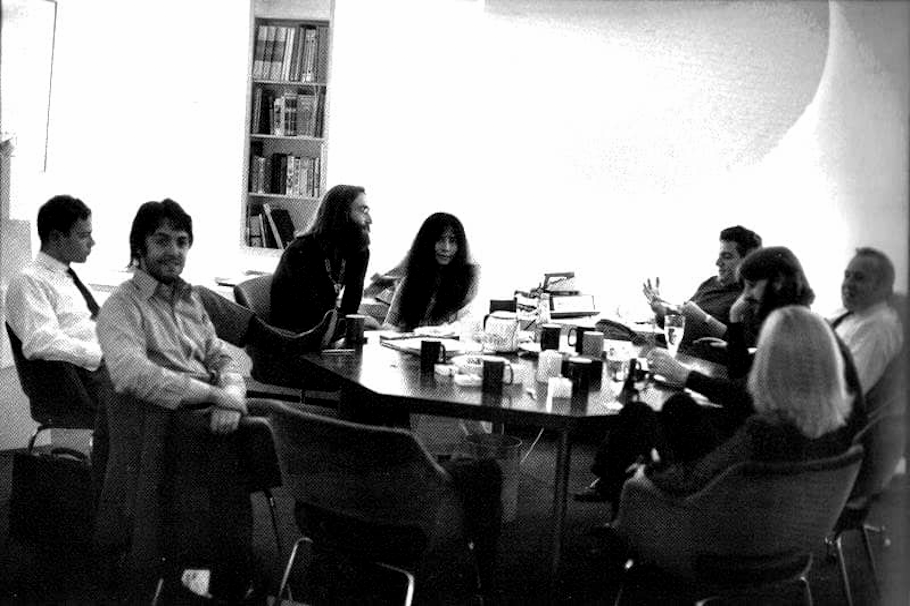
The music publishing company Northern Songs was founded in February 1963 by music publisher Dick James and his partner Charles Silver, with the primary goal of publishing songs written by John Lennon and Paul McCartney.
In March 1969, concerned about the growing influence of Allen Klein in the Beatles’ business affairs—and wary of the American businessman’s reputation—James and Silver decided to sell their shares in Northern Songs to Associated Television (ATV) for £1,525,000.
They did so without notifying John or Paul or offering them the opportunity to buy the shares themselves. The news broke on March 28, 1969, when newspapers reported not only the sale but also ATV’s £9.5 million bid to acquire the remaining shares of the company.
On April 11, 1969, a high-stakes corporate battle began when the media giant ATV launched an official bid to acquire over 1.6 million shares of Northern Songs, the firm responsible for the majority of the Beatles‘ music catalog.
By April 20, the band countered this move after ATV had already managed to increase its stake to nearly 35%. Representing the musicians, Henry Ansbacher & Co. approached shareholders with a superior valuation of 42s 6d per share, a price that topped ATV’s 37s offer. To secure a majority and reclaim their intellectual property, the Beatles sought to buy 1.15 million shares for a total of £2.4 million, planning to finance the acquisition through a £2 million loan.
However, ATV’s chief, Lew Grade, remained unyielding, publicly stating to The Times that their holdings were absolutely not on the market.
This power struggle eventually led a group of London brokerages—including Astaire & Co, WI Carr, and Spencer Thornton—to form a third-party alliance known as the Consortium. By quickly snagging a 14% stake, this group became the deciding factor in the takeover war, as both the Beatles and ATV desperately needed their cooperation to gain the upper hand.
Despite aggressive negotiation attempts by the band’s manager, Allen Klein, he failed to win over the group. Ultimately, Lew Grade bypassed the musicians by offering the Consortium’s Peter Donald 40s per share.
Surprisingly, Donald chose this lower offer over the Beatles’ higher bid, and by September 1969, the band had officially lost the fight, leaving Grade in command of 54% of the company.

 Join the Beatles Subscriber Zone here:
🟠We invite WELCOME! FOLLOW US! VISIT US HERE:
www.beatlesmagazine.com
https://www.facebook.com/BEATLESMAGAZINE1/
https://beatlesmagazine.blogspot.com/
https://beatlesmagazinebootleg.blogspot.com/
https://beatlesmagazinevideo.blogspot.com/
https://www.instagram.com/beatlesmagazine/
https://x.com/BEATLESMAGAZINE
https://www.tiktok.com/@beatlesmagazine
https://www.threads.net/@beatlesmagazine
🟠BEATLES STORES (Associated with Amazon, Shipments Worldwide)→ HERE , HERE & HERE
🟠VISIT PAUL McCARTNEY’s OFFICIAL AMAZON STORE: https://amzn.to/4r3DN4w
#USA 🇺🇸: https://amzn.to/3417JGy
#UK 🇬🇧: https://amzn.to/3qVcsDy
#JAPAN 🇯🇵 : https://amzn.to/3FbWKsO
#GERMANY 🇩🇪: https://amzn.to/3r6s5IB
#FRANCE 🇫🇷: https://amzn.to/3ty8zaX
#SPAIN 🇪🇸: https://amzn.to/3qfiS1s
👉Visit us : https://linktr.ee/BEATLESMAGAZINE
