
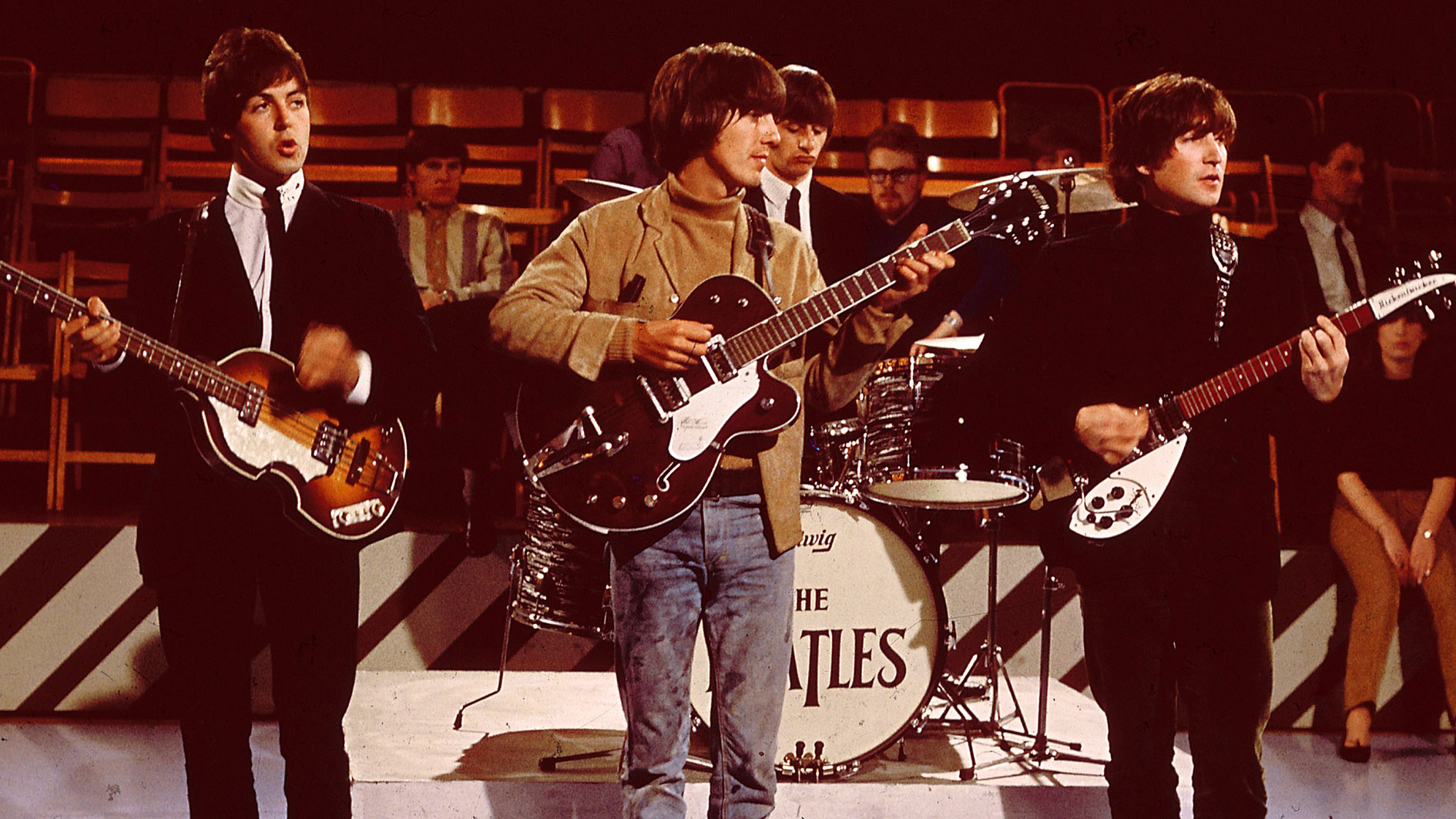
The early sound of The Beatles, the one that captivated millions of people worldwide and defined the “British Invasion,” cannot be understood without the three instruments that accompanied them during that era: John Lennon’s Rickenbacker, Paul McCartney’s Hofner, and George Harrison’s Gretsch. These weren’t just objects; they were an extension of each member’s musical personality and the sonic core of the band.
John Lennon and the Rickenbacker 325
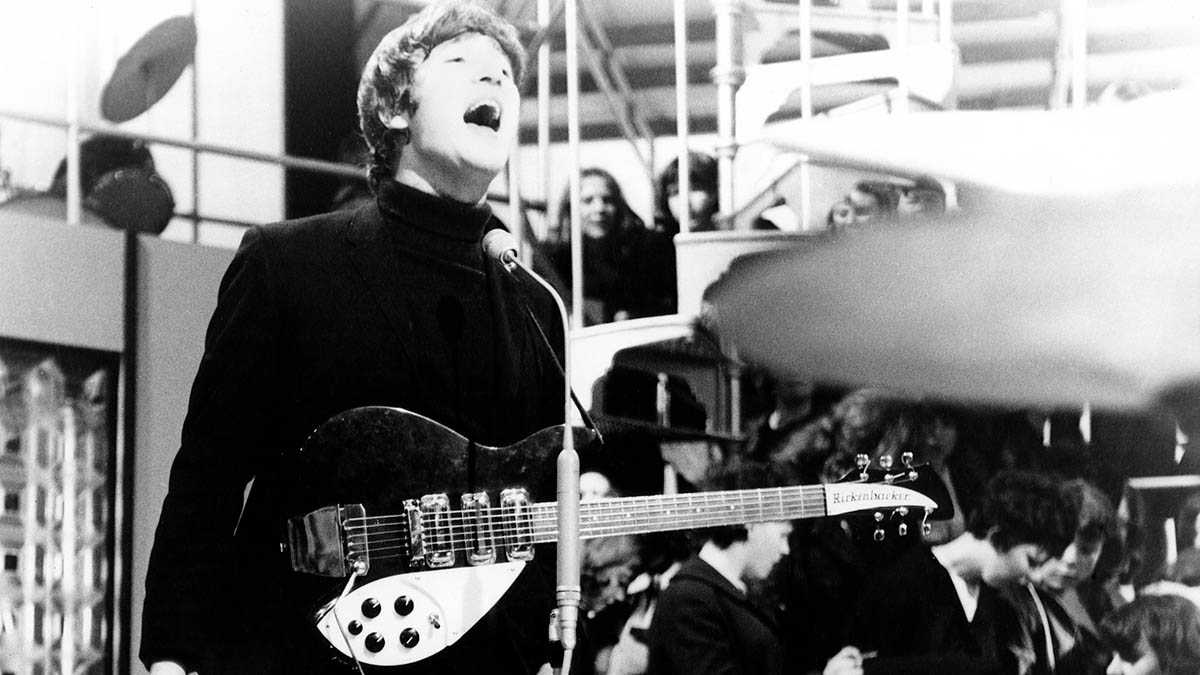
When The Beatles arrived in the United States, John Lennon’s guitar, a Rickenbacker 325, became both a visual and sonic symbol. With its jet black finish, semi-hollow body, and three pickups, this guitar didn’t sound like the popular Gibsons or Fenders in America.
Its tone was sharper and brighter, giving it the distinctive sound heard on early hits like “She Loves You” and “Twist and Shout.” John loved this guitar so much that he used it in the recording of many of the early albums and turned it into an icon of his style. Later, the brand gifted him a 12-string version, the Rickenbacker 360/12, which gave him that characteristic “jangly” sound from the movie A Hard Day’s Night. The resonance of its twin strings became a hallmark of the band during that period and remains one of the most recognizable guitar sounds in rock history.
John Lennon used several Rickenbacker 325s, but his most famous was the 1958 model he bought in Hamburg. This guitar, despite its short scale, became a fundamental part of the band’s early sound.
- Model: Rickenbacker 325 Capri.
- Body Type: Semi-hollow maple body with a double cutaway. Unlike other hollow-body models, it didn’t have “f” holes.
- Neck: Short scale neck, which made it easier for Lennon to play.
- Pickups: Three vintage-style single-coil pickups.
- Bridge: The original 1958 model came with a Kauffman vibrato, which Lennon later replaced with a Bigsby B5. The Rickenbacker 325c64, a later model he also used, featured a Rickenbacker Accent vibrato bridge.
- Finish: The original 1958 model was “Mapleglo” (natural), but Lennon had it painted black in 1962.
- Sound: Its semi-hollow construction and single-coil pickups gave it a bright, percussive sound, ideal for the pop and rock and roll of the era.
Paul McCartney and the Hofner 500/1 ‘Violin Bass’
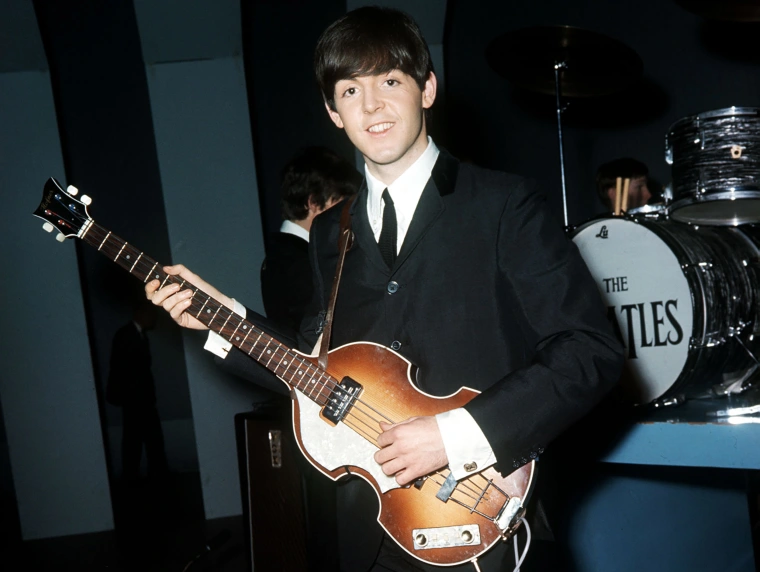
Paul McCartney’s Hofner 500/1 ‘Violin Bass’ is, perhaps, the most iconic instrument of The Beatles. Paul chose this bass early on because, being left-handed, the symmetry of its violin shape felt more comfortable and less awkward than other models. What began as a practical choice became a sonic signature. Unlike most basses of the time, which were limited to marking the rhythm, Paul used his Hofner to create complex and memorable melodies. The warm and full-bodied sound of this instrument is the heart of songs like “Love Me Do” and “All My Loving.” Paul’s bass, with its distinctive melodic lines, elevated the role of the bassist in rock and proved that the bass could be as much of a protagonist as the lead guitar.
The Höfner 500/1, affectionately nicknamed the “Violin Bass” for its distinctive shape, is as inseparable from Paul McCartney’s image as the Beatles’ music itself.
- Model: Höfner 500/1 Violin Bass. Paul used two main models: one from 1961 and another from 1963.
- Body Type: It’s a semi-hollow body bass, which gives it a unique resonance and a more acoustic sound than a solid-body bass. Its shape earned it the “violin bass” nickname.
- Neck: Rosewood fretboard and a maple neck.
- Pickups: Two single-coil pickups. On the 1961 model, the pickups were close together near the neck (the “Cavern Bass”), while on the 1963 model, one pickup was near the neck and the other was closer to the bridge.
- Electronics: Unlike many basses, the Höfner 500/1 had a control panel with switches that allowed for pickup selection, in addition to volume and tone controls.
- Sound: Its semi-hollow construction gives it a warm, round, and very resonant sound. While it may lack the power of a solid-body bass, its tone is unique and perfectly suited for McCartney’s distinctive and melodic bass lines. Also, as a left-handed player, the bass’s symmetrical design made it particularly appealing to him.
George Harrison and his Gretsch Guitars
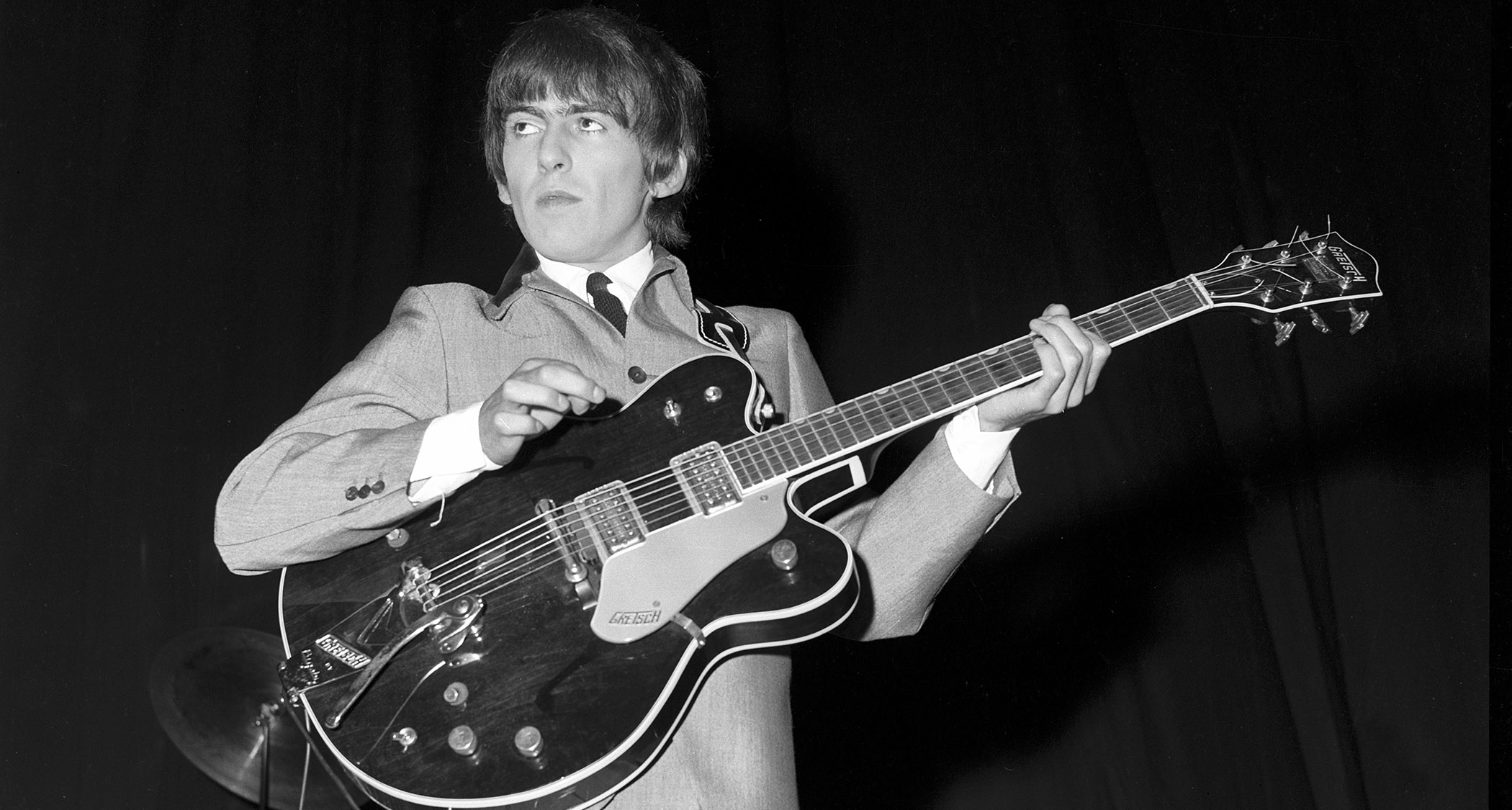
George Harrison, was a seeker of new sounds. In the early years, his Gretsch guitars were his main tool for finding his voice. The Gretsch Duo Jet and, later, the Gretsch Tennessean, gave him a distinctive tone that complemented John’s Rickenbacker. The Gretsches had a smoother, fuller sound that blended perfectly with John’s rhythm guitar. George used them to create the band’s first memorable riffs and showcased his talent as a lead guitarist, a role that was often underestimated in the creative duo of Lennon-McCartney. The Gretsch became George’s go-to instrument during the “Beatlemania” years and is fundamental to understanding the sound of albums like Please Please Me and With the Beatles.
George Harrison used several Gretsch models, but the Duo Jet and the Country Gentleman are the most representative.
Gretsch Duo Jet
- Model: 1957 Gretsch G6128 Duo Jet.
- Body Type: Semi-hollow body with sound chambers, which made it lighter and more resonant than a traditional solid body. The main material was mahogany with a maple top.
- Pickups: Two DynaSonic single-coil pickups, which offered a bright, slightly “twangy” sound, characteristic of the era.
- Bridge: A Bigsby vibrato was often fitted for vibrato effects.
- Sound: Its sound was very distinctive and can be heard on many of the early Beatles recordings. It was a mix of twang, brightness, and resonance.
Gretsch Country Gentleman
- Model: Gretsch G6122 Country Gentleman. George used models from 1962 and 1963.
- Body Type: A large hollow-body guitar with painted-on “f” holes to prevent feedback.
- Pickups: Two Filter’Tron humbucker pickups. These pickups, invented by Gretsch, were known for their clear, powerful tone.
- Additional Features: George’s model included a string mute, a dampening system activated by a lever. It also had a Bigsby bridge.
- Sound: The Country Gentleman had a warmer, more robust sound than the Duo Jet, with more body and sustain, ideal for George’s riffs and solos during the middle period of the Beatles’ career.
🟠Would you like to support the page with a donation? Enter HERE 
🟠We invite you to visit our NEW Facebook Page FOLLOW US HERE:
WELCOME! FOLLOW US! VISIT US HERE:
www.beatlesmagazine.com
https://www.facebook.com/BEATLESMAGAZINE1/
https://beatlesmagazine.blogspot.com/
https://beatlesmagazinebootleg.blogspot.com/
https://beatlesmagazinevideo.blogspot.com/
https://www.instagram.com/beatlesmagazine/
https://x.com/BEATLESMAGAZINE
https://www.tiktok.com/@beatlesmagazine
https://www.threads.net/@beatlesmagazine
🟠BEATLES STORES (Associated with Amazon, Shipments Worldwide)→ HERE , HERE & HERE
#USA 🇺🇸: https://amzn.to/3417JGy
#UK 🇬🇧: https://amzn.to/3qVcsDy
#JAPAN 🇯🇵 : https://amzn.to/3FbWKsO
#GERMANY 🇩🇪: https://amzn.to/3r6s5IB
#FRANCE 🇫🇷: https://amzn.to/3ty8zaX
#SPAIN 🇪🇸: https://amzn.to/3qfiS1s
👉Visit us : https://linktr.ee/BEATLESMAGAZINE
