


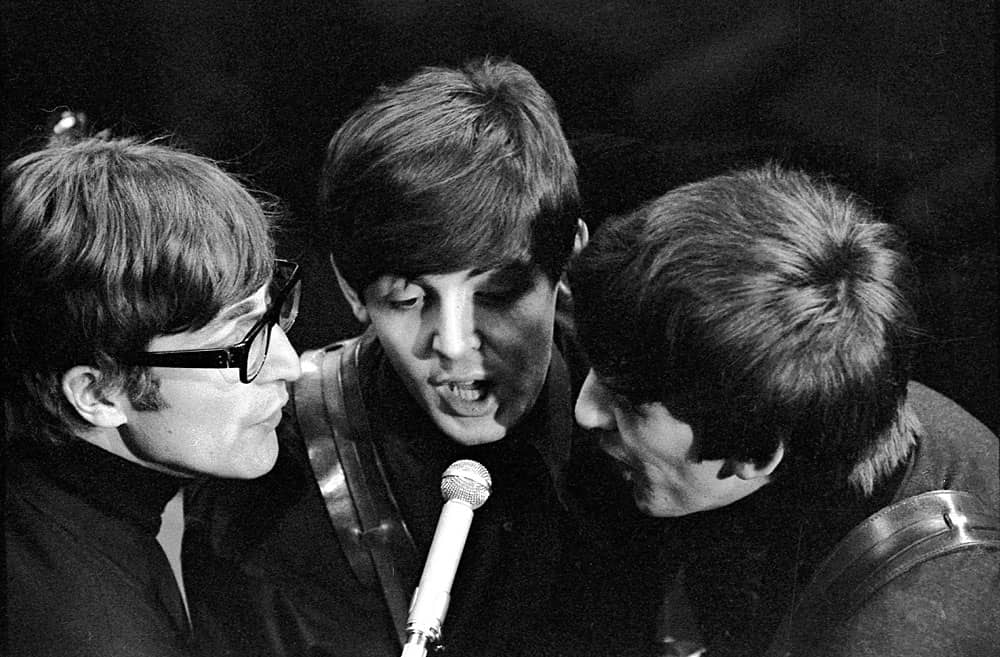
The music of The Beatles is a rich and complex sonic tapestry, and an undeniable thread in their immense legacy is their vocal harmonies. Beyond the individual genius of John Lennon, Paul McCartney, and George Harrison, it was the interaction of their voices that created a unique resonance, elevating their songs from simple melodies to timeless works of art. This article delves into the techniques and impact of these harmonies, analyzing how a quartet from Liverpool redefined the use of the voice in popular music.
From their beginnings in clubs in Hamburg and Liverpool’s Cavern Club, the band already exhibited a remarkable ability for three-part singing. Inspired by R&B and doo-wop groups like The Everly Brothers and Little Richard, they developed an intuitive yet effective approach. Initially, the structure usually featured a lead vocalist (often Lennon or McCartney) with the other two voices providing close harmonies above and below the main melody, or sometimes in parallel. This technique created a sense of fullness and brilliance, as heard in early tracks like “Please Please Me” or “From Me to You.” Homophonic texture predominated, where the voices moved rhythmically in unison, but at different tonal heights.

“This Boy” is a brilliant showcase of their vocal abilities. The song is distinguished by its complex three-part harmonies, primarily from John, Paul, and George, often utilizing major sevenths which give it a melancholic tone. John Lennon takes the lead with an emotive and vulnerable main vocal. The vocal melody has a wide range, designed to maximize emotional impact. Together, these techniques resulted in a timeless and moving ballad.
As their career progressed, so did the sophistication of their vocal arrangements. The influence of folk music and studio experimentation under the guidance of George Martin led them to explore open harmonies, with wider intervals between the voices, adding greater depth and air to their sound. Songs like “Nowhere Man” are an excellent example of Lennon, McCartney, and Harrison singing all three parts in complex vocal counterpoint, where each voice has an independent yet complementary melodic line.
A hallmark of The Beatles was their mastery of vocal role swapping. It was not uncommon for a song to feature one Beatle leading the verse, another taking the chorus, and the third providing a crucial harmony in a bridge. This fluidity not only maintained listener interest but also allowed the song to develop organically. “Help!” or “Ticket to Ride” illustrate how the alternation of lead vocals and background harmonies created an ever-evolving dynamic.

In “If I Needed Someone,” tight harmonies are used, meaning the notes are very close to each other, creating a dense and cohesive sound. In “What Goes On,” secondary harmonies are used to add texture, but the focus clearly lies on Ringo’s straightforward vocal delivery, which complements the song’s country-folk nature.
The most prominent vocal part in “The End” is the final chorus and the famous tag line: “And in the end, the love you take is equal to the love you make.” Here, the three voices of John, Paul, and George unite in a powerful and resonant harmony, singing in unison or in very close harmonies, creating a great emotional impact and a sense of grand closure.
From a technical standpoint, the impeccable tuning and cohesion of their voices were fundamental. While not classically trained vocalists, they possessed exceptional rhythmic synchronization and an instinctive ability to blend their timbres. McCartney, with his high and clear register, often provided the upper harmony voice, while Lennon’s rougher voice served as a melodic anchor, and Harrison filled the space in between. This combination of timbres, though distinct, complemented each other brilliantly. Studio recording allowed them to refine these takes, often doubling vocal tracks to achieve a denser sound, a technique that became standard in music production.
The impact of The Beatles’ vocal harmonies transcended mere aesthetics. They became an integral part of their sonic identity, imbuing their songs with emotional depth and instant recognition. Their influence is palpable in countless later artists, from Queen to Fleetwood Mac, demonstrating that carefully crafted vocal interaction can be as powerful and memorable as any lead melody. The harmonies of The Beatles were not just an embellishment; they were the beating heart of their music, the alchemy that transformed the ordinary into the extraordinary.
🟠Would you like to support the page with a donation? Enter HERE 
🟠We invite you to visit our NEW Facebook Page FOLLOW US HERE:
WELCOME! FOLLOW US! VISIT US HERE:
www.beatlesmagazine.com
https://www.facebook.com/BEATLESMAGAZINE1/
https://beatlesmagazine.blogspot.com/
https://beatlesmagazinebootleg.blogspot.com/
https://beatlesmagazinevideo.blogspot.com/
https://www.instagram.com/beatlesmagazine/
https://x.com/BEATLESMAGAZINE
https://www.tiktok.com/@beatlesmagazine
https://www.threads.net/@beatlesmagazine
🟠BEATLES STORES (Associated with Amazon, Shipments Worldwide)→ HERE , HERE & HERE
#USA 🇺🇸: https://amzn.to/3417JGy
#UK 🇬🇧: https://amzn.to/3qVcsDy
#JAPAN 🇯🇵 : https://amzn.to/3FbWKsO
#GERMANY 🇩🇪: https://amzn.to/3r6s5IB
#FRANCE 🇫🇷: https://amzn.to/3ty8zaX
#SPAIN 🇪🇸: https://amzn.to/3qfiS1s
👉Visit us : https://linktr.ee/BEATLESMAGAZINE
