

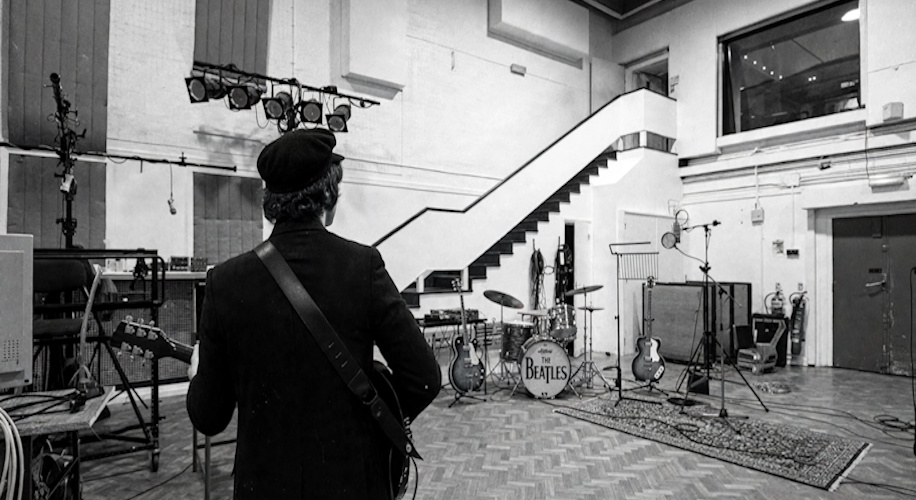
In the historical narrative of The Beatles, roles are often perceived as static: Paul McCartney on bass, George Harrison on lead guitar, Ringo Starr on drums, and John Lennon on lead vocals and rhythm guitar. However, the Liverpool quartet’s dynamics were notable for their versatility. A crucial milestone in the group’s sound evolution occurred in 1964, when Lennon assumed the role of lead guitarist in the studio for the first time during the recording of “You Can’t Do That.”
Released as the B-side to the hit single “Can’t Buy Me Love” and later included on the album A Hard Day’s Night, “You Can’t Do That” represents a decisive moment. For this performance, Lennon used his iconic Rickenbacker guitar, delivering a solo characterized by a direct, biting, and melodically straightforward style. Far from seeking technical polish or academic virtuosity, John’s playing directly evoked his 1950s influences, drawing inspiration from raw early rock and roll and pioneers like Chuck Berry and Carl Perkins.
This showcase was not an isolated event, but rather the opening of an instrumental facet that Lennon would periodically explore throughout the band’s catalog:
John’s approach to the lead guitar brought a visceral energy and a distinct rhythmic attack compared to Harrison’s usual melodic precision.
Years later, he would demonstrate that same technical punch in the distorted blues of “Get Back,” the elegant nuances of “Honey Pie,” and in the famous three-way guitar duel on “The End” from the album Abbey Road.
John Lennon‘s solo on “You Can’t Do That” proves that lead guitar doesn’t always require pyrotechnic virtuosity to be memorable. In a pop landscape that was leaning toward polished production in 1964, the sharp attack of his Rickenbacker provided an indispensable bluesy grit; it is a reminder that attitude, timing, and rhythmic authenticity can transform a few simple notes into an unforgettable aesthetic statement.
It is very likely that John Lennon decided to take control of the solo to inject a raw, rough, and bluesy touch, faithfully reflecting his visceral musical vision for the track. By stepping up as lead guitarist, he infused the song with a direct, imperfect energy that perfectly captured his artistic identity.
……………………………………………………
🟠Would you like to support the page with a donation? Enter HERE
 Join the Beatles Subscriber Zone here:
🟠We invite WELCOME! FOLLOW US! VISIT US HERE:
www.beatlesmagazine.com
https://www.facebook.com/BEATLESMAGAZINE1/
https://beatlesmagazine.blogspot.com/
https://beatlesmagazinebootleg.blogspot.com/
https://beatlesmagazinevideo.blogspot.com/
https://www.instagram.com/beatlesmagazine/
https://x.com/BEATLESMAGAZINE
https://www.tiktok.com/@beatlesmagazine
https://www.threads.net/@beatlesmagazine
🟠BEATLES STORES (Associated with Amazon, Shipments Worldwide)→ HERE , HERE & HERE
🟠VISIT PAUL McCARTNEY’s OFFICIAL AMAZON STORE: https://amzn.to/4r3DN4w
#USA 🇺🇸: https://amzn.to/3417JGy
#UK 🇬🇧: https://amzn.to/3qVcsDy
#JAPAN 🇯🇵 : https://amzn.to/3FbWKsO
#GERMANY 🇩🇪: https://amzn.to/3r6s5IB
#FRANCE 🇫🇷: https://amzn.to/3ty8zaX
#SPAIN 🇪🇸: https://amzn.to/3qfiS1s
👉Visit us : https://linktr.ee/BEATLESMAGAZINE
