

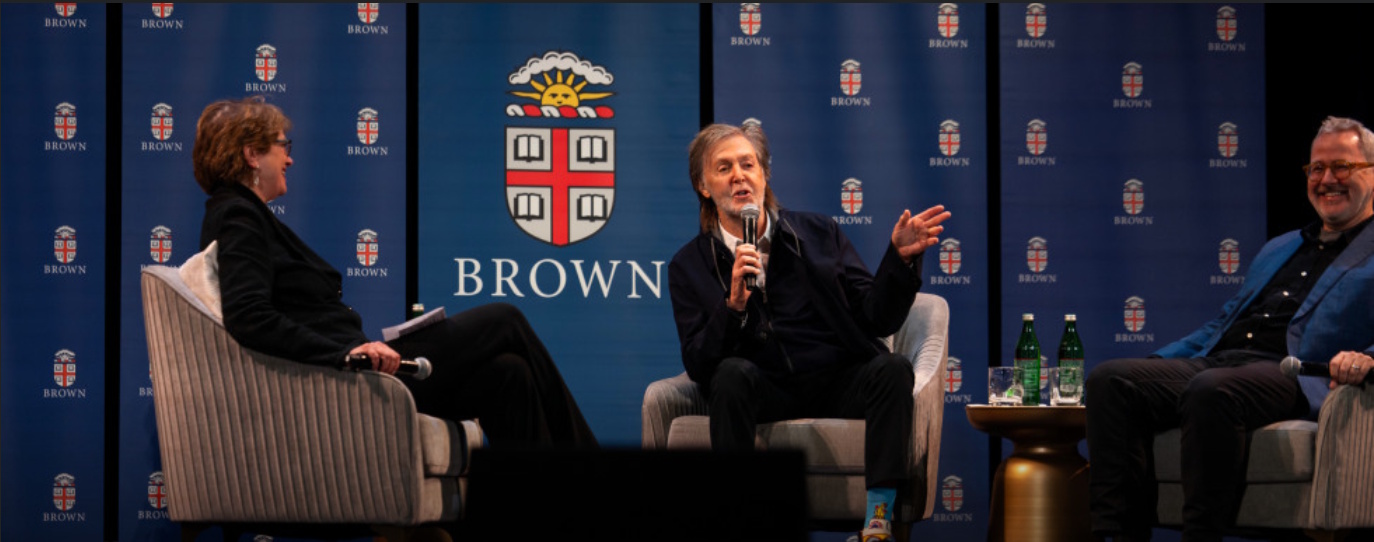
At a packed premiere and dialogue led by President Christina H. Paxson, Paul McCartney teamed up with director Morgan Neville to explore themes of transformation, heartbreak, and the relentless itch to innovate. Following a screening of “Man on the Run” at the Veterans Memorial Auditorium on April 20, the duo engaged with the Brown University community.
When McCartney first invited Neville to a private viewing, the Oscar-winning filmmaker admitted to being incredibly anxious—despite being the visionary behind the project. Neville felt an immense obligation to accurately capture the documentary’s core: the birth and ascent of Wings, McCartney’s legendary second act.
During that initial viewing, Neville overheard McCartney’s grandchildren reacting to the footage. One mentioned they had never actually heard their grandmother Linda’s speaking voice, while another was shocked to learn their “Grandpa went to jail.” McCartney confirmed these anecdotes to the laughing audience.
The event, which saw nearly 2,000 attendees including McCartney’s own granddaughter (a Brown student), focused on a film that uses rare archives to highlight McCartney’s personal and professional shift. It portrays an icon finding his footing alongside Linda McCartney while the entire world scrutinized his every move.
Neville’s strategy for the film was unique; he built a “soundtrack” of McCartney’s solo and Wings-era work first, using the lyrics as a narrative map. He noted that songwriters often narrate their own lives through their compositions, which helped dictate the emotional flow of the documentary.
The story reveals a man driven by a restless creative spirit, pushing through moments that might have stalled others—from awkward TV specials to legal troubles abroad. McCartney confessed that watching some of these cringeworthy moments made him squirm, but Neville insisted that these “failures” were essential learning blocks that evolved in meaning over time.
The film dives deep into the vacuum left after his partnership with John Lennon ended in 1970. Facing a harsh media landscape that labeled him the villain in the band’s split, McCartney retreated to the rugged hills of Scotland. There, he embraced a quiet life of farming and family, which provided the “grounding” he lacked during the peak of Beatlemania.
Seeing Linda, who passed in 1998, proved to be a bittersweet highlight for McCartney. He described the experience as both painful and “glorious,” particularly witnessing her sharp sense of humor again. The documentary also softens the narrative of his relationship with Lennon, moving past the “rivalry” trope to show their underlying affection. This perspective was bolstered by insights from Sean Ono Lennon, who McCartney noted “sensed the truth” of their bond despite his youth at the time.
As the evening concluded, the discussion turned to what keeps McCartney motivated after decades of unmatched success. While Neville attributed it to an endless sense of wonder, McCartney kept it simple: it’s pure enjoyment. He explained that even if it weren’t his profession, music would be his hobby, as he is still chasing that “magical” eureka moment found in a new chord or a fresh discovery.
Photos:Brown University

 Join the Beatles Subscriber Zone here:
🟠We invite WELCOME! FOLLOW US! VISIT US HERE:
www.beatlesmagazine.com
https://www.facebook.com/BEATLESMAGAZINE1/
https://beatlesmagazine.blogspot.com/
https://beatlesmagazinebootleg.blogspot.com/
https://beatlesmagazinevideo.blogspot.com/
https://www.instagram.com/beatlesmagazine/
https://x.com/BEATLESMAGAZINE
https://www.tiktok.com/@beatlesmagazine
https://www.threads.net/@beatlesmagazine
🟠BEATLES STORES (Associated with Amazon, Shipments Worldwide)→ HERE , HERE & HERE
🟠VISIT PAUL McCARTNEY’s OFFICIAL AMAZON STORE: https://amzn.to/4r3DN4w
#USA 🇺🇸: https://amzn.to/3417JGy
#UK 🇬🇧: https://amzn.to/3qVcsDy
#JAPAN 🇯🇵 : https://amzn.to/3FbWKsO
#GERMANY 🇩🇪: https://amzn.to/3r6s5IB
#FRANCE 🇫🇷: https://amzn.to/3ty8zaX
#SPAIN 🇪🇸: https://amzn.to/3qfiS1s
👉Visit us : https://linktr.ee/BEATLESMAGAZINE
