

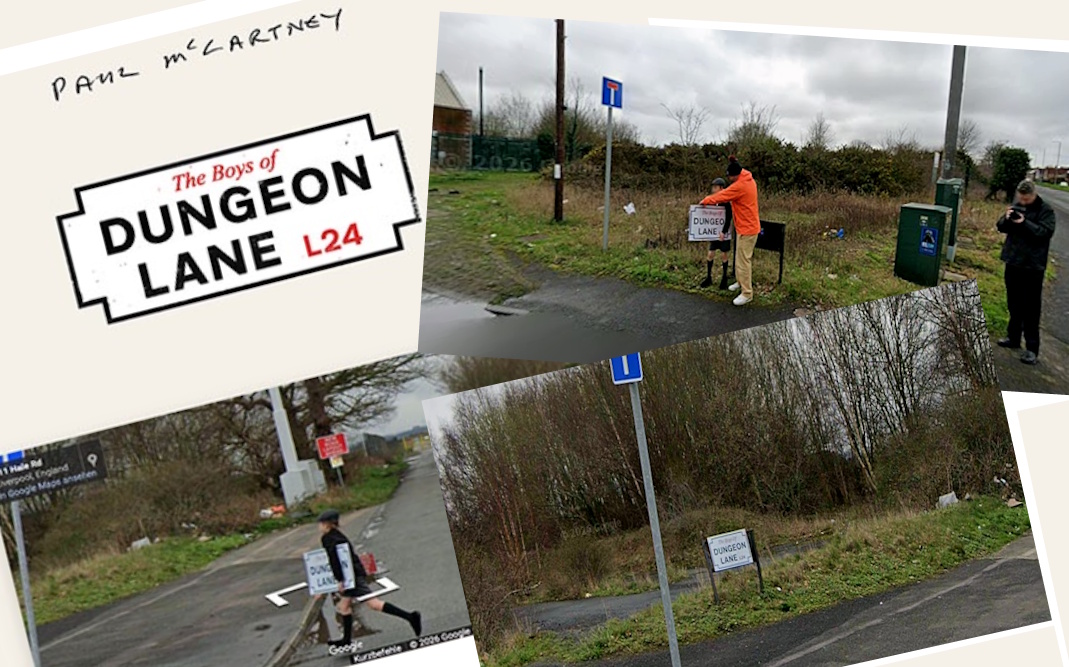
The appearance of that young boy holding the Dungeon Lane sign on Google Maps is a fascinating and recent milestone in the history of digital music promotion. This was a deliberate collaboration between Paul McCartney and Google Street View to promote his latest album; the image you see was captured specifically for this purpose.

To bring this to life, Google updated the coordinates of Dungeon Lane—located near the Liverpool airport—to feature a young actor dressed in a 1950s school uniform, evoking Paul’s own childhood. The goal was to create a digital “treasure hunt” experience. By entering the address, fans discover an image that feels frozen in time, strikingly breaking the modern aesthetic of the map. There is even a clever technical detail: if you look closely at the Google Maps watermark at those specific coordinates, you’ll notice the image date has been altered or linked to the album’s launch campaign, seamlessly blending the real world with the record’s narrative.
Dungeon Lane is situate d in Speke, a suburb in south Liverpool, very close to what is now the John Lennon Airport (formerly Speke Airport).
During the 1950s and 60s, this area was a frequent haunt for Paul McCartney and George Harrison, who both grew up in Speke. Living in the same neighborhood was pivotal to their friendship, as they both took the same school bus to the Liverpool Institute. The Harrison family moved to 25 Upton Green in 1949 when George was six, living there until the early 60s.
 That house is legendary as an early rehearsal space for The Quarrymen, the band that preceded the Beatles. Meanwhile, Paul lived at 12 Ardwick Road, just around the corner from the Harrisons, and attended Stockton Wood Primary School in the same district.
In those post-war years, Dungeon Lane was the path leading toward the River Mersey, passing through fields and farms. It was a place of freedom where local youths would ride their bikes, watch planes take off, or simply wander through the countryside. At the time, Speke was a new housing development, and Dungeon Lane marked the boundary between urban growth and the wild nature by the river.

Today, the area has taken on an industrial and nostalgic character. While the street has lost much of its rural charm—now surrounded by the airport perimeter and industrial zones—it remains a pilgrimage site for Beatles fans. It represents the physical geography that inspired the introspection found in Paul’s lyrics.

The title of the LP makes a direct reference to the group of friends and the identity of the children who grew up on the city’s periphery. The atmosphere of these walks along Dungeon Lane heavily influenced the nostalgic new tracks Paul presents in his upcoming album.
This “sense of a childhood place transformed” serves as the creative engine for this project. As Dungeon Lane ends near the runway, Paul has recalled in interviews how watching the planes from that vantage point made him dream of “seeing the world”—a sentiment he later shared with John Lennon during their earliest songwriting sessions.

 Join the Beatles Subscriber Zone here:
🟠We invite WELCOME! FOLLOW US! VISIT US HERE:
www.beatlesmagazine.com
https://www.facebook.com/BEATLESMAGAZINE1/
https://beatlesmagazine.blogspot.com/
https://beatlesmagazinebootleg.blogspot.com/
https://beatlesmagazinevideo.blogspot.com/
https://www.instagram.com/beatlesmagazine/
https://x.com/BEATLESMAGAZINE
https://www.tiktok.com/@beatlesmagazine
https://www.threads.net/@beatlesmagazine
🟠BEATLES STORES (Associated with Amazon, Shipments Worldwide)→ HERE , HERE & HERE
🟠VISIT PAUL McCARTNEY’s OFFICIAL AMAZON STORE: https://amzn.to/4r3DN4w
#USA 🇺🇸: https://amzn.to/3417JGy
#UK 🇬🇧: https://amzn.to/3qVcsDy
#JAPAN 🇯🇵 : https://amzn.to/3FbWKsO
#GERMANY 🇩🇪: https://amzn.to/3r6s5IB
#FRANCE 🇫🇷: https://amzn.to/3ty8zaX
#SPAIN 🇪🇸: https://amzn.to/3qfiS1s
👉Visit us : https://linktr.ee/BEATLESMAGAZINE
