


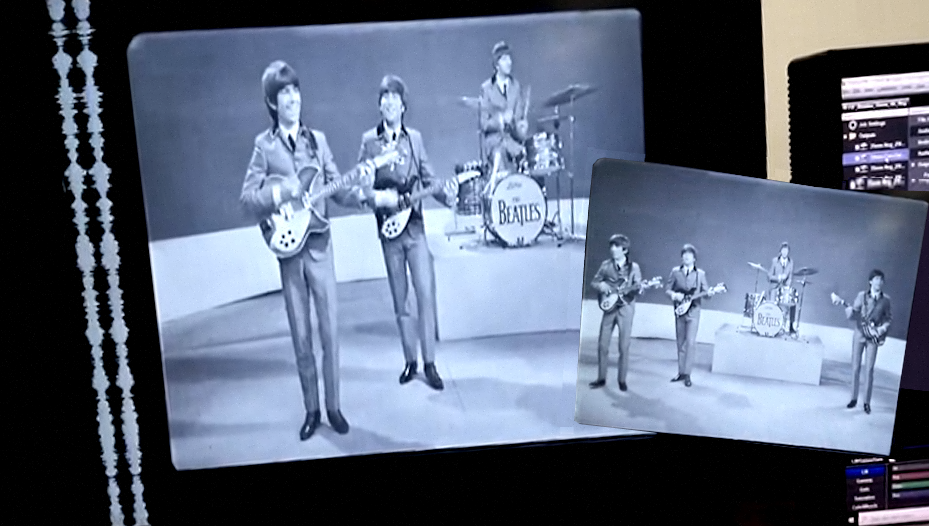
Footage and reels of The Beatles on the BBC program Top Of The Pops were material previously considered lost, as the British broadcaster used to wipe its original tapes. However, thanks to recent finds and preservation efforts by organizations such as Film Is Fabulous!, important fragments have been recovered and restored.
These historical recoveries are:
‘Top Of The Pops’ 1964: The 35mm negative of the band’s first appearance on the show was recently located. In June 2026, the organization Film Is Fabulous! located the complete reel of the band’s first historic appearance on the program. This recovered material includes multiple takes recorded on March 19, 1964:
Can’t Buy Me Love (4 recovered takes, including two that were aborted due to technical errors in the studio).
You Can’t Do That (2 recovered takes; in the second one, John Lennon can be seen making faces at the camera during a close-up shot).
The technical restoration focuses on eliminating screen flicker (caused by the CRT technology of the era) and synchronizing the original audio.
The discovery of The Beatles‘ footage on the 1964 Top of the Pops hides technical and human secrets that amaze archivists. The recent revelation of this material—found and processed by the organization Film Is Fabulous!—provides unpublished details that go far beyond the band’s simple musical performance.
The original film can containing the 35mm negative was not found in a corporate warehouse. It belonged to the private collection of a deceased television industry professional and was handed over anonymously by his family during the British Film Collectors Convention held in Surrey. This original celluloid format endows the restoration with incalculable value. To date, the few existing clips of the debut were very noisy home recordings made by pointing 8mm cameras directly at the screens of televisions from that era.
The restoration of the tape has uncovered valuable minutes of “bloopers” and technical production errors. Due to failures in the BBC‘s equipment, the group had to repeat the songs multiple times. Far from being frustrated, the restored footage shows the musicians joking openly between takes, dancing on the set to amuse themselves, and chatting casually with the makeup artists and studio technicians.
Once the high-definition digital scanning process is complete, the material will formally return to the official BBC archives. Active discussions are currently underway with Apple Corps to define the date of its global mass broadcast.
The exact process that revolutionized The Beatles‘ audio recovery is based on artificial intelligence de-mixing technology, originally developed by Peter Jackson’s team at WingNut Films. This tool, internally named M.A.L. (Machine Audio Learning), was designed specifically to solve the major problem of the BBC archives: embedded monoaural audio.
The software does not perform traditional equalization, but instead uses deep learning algorithms. Thousands of hours of clean, isolated recordings of the group were fed into the AI to “teach” it the specific spectral footprints of each element:
The exact vocal timbre of John Lennon.
The acoustic signature of Paul McCartney‘s Höfner bass.
The mechanical sound and impact of Ringo Starr‘s drums.
The distortion patterns and harmonics of George Harrison‘s guitars.
Upon processing the single (mono) audio track coming from the found 1964 35mm reel, the AI analyzes the visual spectrogram of the sound in milliseconds. The system recognizes the mixed instruments and “draws” them separately. Upon identifying a wave as “John’s voice,” it surgically extracts it from the rest of the sound mass, dividing the original track into four or five independent subtracks called stems.
On 1960s BBC tapes, instruments were frequently masked by the electrical hum of analog equipment, the physical tape hiss, and the reverberation of the theater itself. Once the AI separates the voice or drums onto their own stem, sound engineers apply inverse filters: they remove the ambient noise trapped in that specific track without damaging the music’s frequencies, something impossible with past restoration technology.
With the elements clean and completely separated, the material is handed over to a traditional audio mixer in a digital environment (DAW). Engineers can, for the first time in 60 years, turn up the guitar volume, center the lead vocal, send the drums to the left channel, and create a modern, crisp stereo mix with spatial depth, transforming the flat audio of old television into a contemporary sound experience.
Images: Filmisfabulous
……………………………………………………
🟠Would you like to support the page with a donation? Enter HERE
 Join the Beatles Subscriber Zone here:
🟠We invite WELCOME! FOLLOW US! VISIT US HERE:
www.beatlesmagazine.com
https://www.facebook.com/BEATLESMAGAZINE1/
https://beatlesmagazine.blogspot.com/
https://beatlesmagazinebootleg.blogspot.com/
https://beatlesmagazinevideo.blogspot.com/
https://www.instagram.com/beatlesmagazine/
https://x.com/BEATLESMAGAZINE
https://www.tiktok.com/@beatlesmagazine
https://www.threads.net/@beatlesmagazine
🟠BEATLES STORES (Associated with Amazon, Shipments Worldwide)→ HERE , HERE & HERE
🟠VISIT PAUL McCARTNEY’s OFFICIAL AMAZON STORE: https://amzn.to/4r3DN4w
#USA 🇺🇸: https://amzn.to/3417JGy
#UK 🇬🇧: https://amzn.to/3qVcsDy
#JAPAN 🇯🇵 : https://amzn.to/3FbWKsO
#GERMANY 🇩🇪: https://amzn.to/3r6s5IB
#FRANCE 🇫🇷: https://amzn.to/3ty8zaX
#SPAIN 🇪🇸: https://amzn.to/3qfiS1s
👉Visit us : https://linktr.ee/BEATLESMAGAZINE
